







Westchester Executives Weigh in on Artificial Intelligence, Healthcare Costs, and Economic Outlook for 2026
As a volatile year concludes, the Business Council of Westchester (BCW) gathered regional leaders on Tuesday to forecast the upcoming financial landscape.
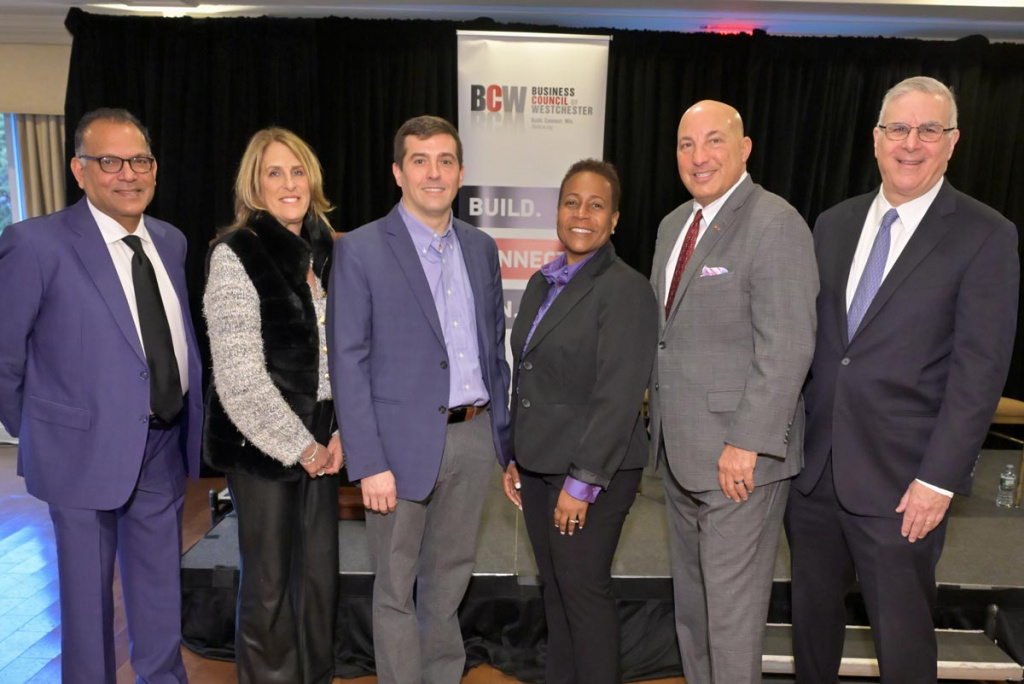
The KeyBank Speaker Series event, The Next Economic Chapter: From 2025 Realities to 2026 Opportunities, offered a blend of high-level economic data and ground-level operational realities. The breakfast featured a presentation by Brian Pietrangelo, Managing Director of Investment Strategy at Key Private Bank, followed by a diverse panel of local executives moderated by BCW Executive Vice President and COO John Ravitz.
“Every year, the BCW appreciates hearing from senior KeyBank financial analysts who have a pulse on the numerous economic trends that businesses in Westchester County must keep up with,” said Ravitz.
Pietrangelo began the morning at Tappan Hill Mansion in Tarrytown by dissecting the mixed signals of the 2025 economy, noting that while the S&P 500 is up nearly 18% through November, inflation remains a persistent challenge, hovering above the Federal Reserve’s 2% target. He highlighted the bifurcated nature of the current economy—often described as K-shaped—where higher net-worth individuals continue to drive consumer spending while lower-income brackets face tightening pressures.
Looking toward 2026, Pietrangelo advised a balanced approach, suggesting the rapid growth seen recently may temper.
“We’re continuing to see some good steam within the economy heading into 2026,” Pietrangelo said. “At some point… overall economic activity will slow as we go into 2026 and probably be significantly less than a 4% quarterly growth rate.”
Following the forecast, Ravitz led a panel discussion featuring Corine Lurry-Mabin, President and CEO of Andrus; Raj Ratan, CEO of Burke Neurological Institute; Oliver Stauffer, CEO of PTI; and Stacey Tompkins, President of Tompkins Excavating.
The panelists represented a diversity of organizations.
“We felt it was important to have executives from both the private and public sectors lead a discussion of economic trends that their respective industries are seeing,” Ravitz said.
Ratan provided a sobering look at the intersection of demographics and economics. He noted that 180 million Americans currently live with a neurological condition, a number expected to rise as the population ages.
“If you just project out to 2050, if you take the two leading causes of neurological disability, Alzheimer’s and stroke, they’re projected to cost the U.S. $1.4 trillion a year,” Ratan said. “With decreasing federal dollars, we have an increased burden, and we have an urgency to solve the problem.”
The conversation shifted to the universal challenge of employee retention and difficult operational choices. Lurry-Mabin discussed how Andrus had to perform a risk analysis that led to cutting certain programs to save the organization’s core mission.
“It allowed us to put our focus back on… recruiting and retaining staff so that we can strengthen our core,” said Lurry-Mabin, referring to a program that lacked adequate staffing.
Tompkins noted that her company has adopted a slow-to-hire approach, focusing on culture and efficiency to navigate higher costs.
“We’re doing the same or more with less, which I think is crucial and very important in this world,” Tompkins said. “We are recruiting from within and bringing some of the middle crew leaders that are on the front lines and involving them in our management meetings.”
Stauffer addressed the elephant in the room: AI. While acknowledging the technology’s efficiency, he highlighted the anxiety it causes among the workforce.
“We’re taking an employee-first approach to AI,” Stauffer said. “That’s essentially a commitment that no one at PTI will lose their job due to AI. If we make that commitment, I can, in fact, move that younger demographic to adopt AI.”
The panel concluded with a consensus that while 2026 poses regulatory and fiscal uncertainties, success will depend on operational efficiency, adopting innovative technologies without alienating staff, and maintaining strong community partnerships.
“We are grateful that each of our panelists were able to share the different priorities and directions that they are taking their organizations in to deal with the day-today challenges that all businesses are facing in these uncertain economic times,” said Ravitz.
Similar News Items
CLICK HERE to watch An Experiential Economy: The Transformation of Retail & Hospitality.
In big news on the retail front, announced at Wednesday’s Business Council of Westchester and Fordham University Real Estate Institute event, BCW Member Marx Realty announced this week it has begun construction on a two-building, 58,000-square-foot retail expansion at Cross County Center in Yonkers. The 1.15 million-square-foot retail center is now home to over 100 […]
RYE BROOK, NY – The digital transformation of Westchester County’s small business landscape took a significant leap forward on Tuesday as The Business Council of Westchester (BCW) launched the first session of its “AI Intensive 2026.” Supported by Google.org, the groundbreaking professional development program aims to provide local enterprises with the tools and expertise necessary […]
Become A Member
Join the county’s largest and most influential business organization today.
JOIN NOW!