






AI Alliance 360 Impact Summit: Executives Urge Reinvention Through Adoption
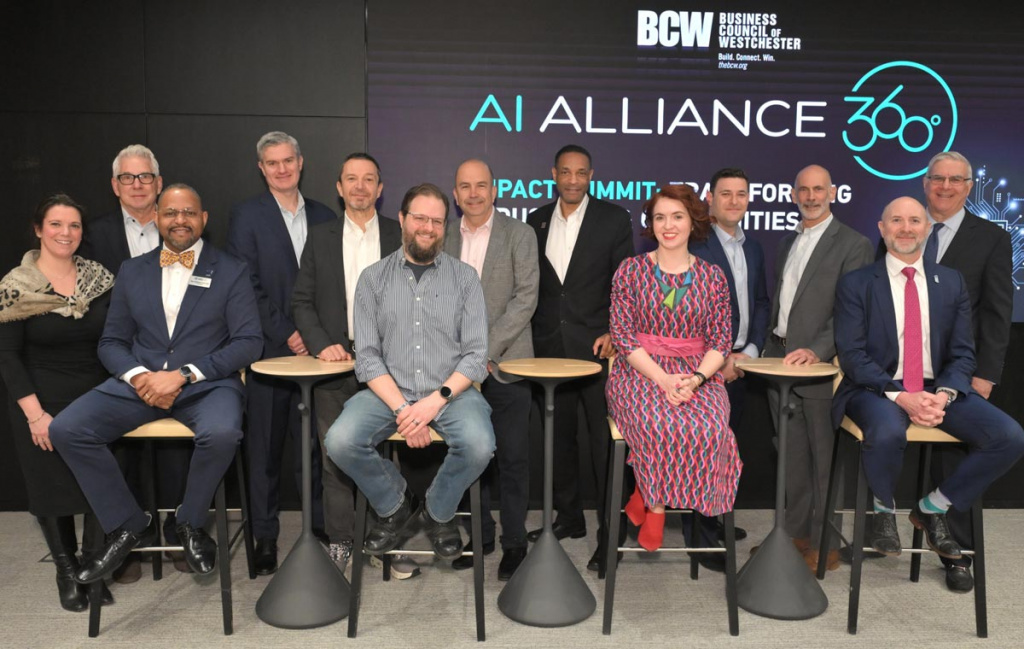
From left, BCW Senior Vice President of Events & Development Amanda DePalma; David Gross (GF55 Architects); Rey Hollingsworth (HGAR); Andy Bryant (IBM); Oleg Tumanov (Selsa); Rob Kissner (Iona University); Paul Tyler ( Zinnia); Antony Haynes (Dorf Nelson Zauderer); Kathleen Reckling (ArtsWestchester); Moish Peltz (Falcon Rappaport Berkman); Steven Mines (The Mines Press);Chad Scholes (Metro-North Railroad) and BCW Executive Vice President and COO John Ravitz
Business leaders from across the county gathered on Monday for the Business Council of Westchester’s (BCW) AI Alliance 360 Impact Summit to discuss the rapidly shifting landscape of artificial intelligence.
Led by John Ravitz, Executive Vice President and COO of the BCW, a panel of experts from IBM, local law firms, and regional enterprises warned that simply using AI as an office assistant is no longer enough to remain competitive.
The discussion centered on the transition from traditional machine learning to generative AI, the necessity of internal governance, and the emergence of the “AI Champion” as a critical corporate role. “We have made this a commitment at the BCW through our AI Alliance program, through the work that we’re finishing up with Google.org, and a new, exciting program,” said Ravitz. “It’s our intention to make sure that every business in every sector can have a front row seat to continue to learn about all of this.”
Transforming the Enterprise: From Strategy to Workflow
The panel opened with a look at how global giants and local firms alike are restructuring. Andy Bryant, Strategy & Solutions Leader at IBM, highlighted that the goal isn’t just automation, but a complete rethinking of business processes through the mantra of eliminating, simplifying, and automating. “We’re not automating bad business processes. We’re targeting business processes where we can reinvent them and then rebuild them with AI in the best possible way,” said Bryant.
For smaller Westchester-based firms, the impact is equally dramatic. Steven Mines, President of The Mines Press, shared how his company connected the AI platform Claude to his enterprise resource planning system. “If I want to ask a question that you normally might ask a CFO, like, we have a special discount deal with these 300 stores that are members of this organization. Do we make money on that?” said Mines. “Now I can go in and just ask Claude, and it comes back with an incredible response.”
Navigating the “Sovereign Stack” and Legal Landmines
As AI agents begin to draft contracts and analyze risk, the legal experts on the panel emphasized that consumer-grade AI is a liability. Antony Haynes, Partner at Dorf Nelson & Zauderer, introduced the concept of the Sovereign Stack—using in-house, custom AI to protect trade secrets and build unique value. “We know what’s happening with respect to our clients and needs. Your AI learns that, and that becomes your competitive advantage. Your competitors don’t know your clients like you do,” explained Haynes.
Moish Peltz, Co-Managing Partner at Falcon Rappaport & Berkman LLP, stressed the importance of AI policy. He warned against “shadow AI,” where employees perform company work on public tools like ChatGPT on personal devices without corporate oversight. “It’s a full organizational effort to really be responsible, to train, to get everyone in the organization engaged doing this in the right way,” said Peltz.
The Winners and Losers of the AI Shift
Oleg Tumanov, Founder and Executive Chairman of Selsa, said that the AI winners are companies with heavy data—such as healthcare and financial services—while potential losers are those reliant on repetitive, text-based tasks. “All these (text-based) companies, if they do not figure out how to use AI and completely reshape their business, will become obsolete very soon,” warned Tumanov.
For those looking to implement these tools immediately, Paul Tyler, Head of Enterprise Marketing and Innovation at Zinnia, suggested starting with specific friction points rather than broad software overhauls. He shared how his firm used AI to build interactive training programs for sales teams in a fraction of the traditional time. “Until you actually get your sleeves rolled up, you’re not going to know what’s possible,” said Tyler.
The second segment of the AI Alliance 360 conference shifted the focus to practical applications across architecture, transportation, the arts, real estate, and academia.
Architecture and Physical Creation
David Gross, Executive Partner at GF55 Architects, said that in his office the human interface remains the essential element of a design process after AI has sorted through complex data like the New York City Building Code. “What [AI] doesn’t do yet is tell you what it means. We still have to have the human brain filtering and synthesizing all the data,” said Gross.
Transportation and Public Safety
Chad Scholes, Chief Innovation and Logistics Officer at Metro-North Railroad, shared how the railroad is utilizing AI to move up to 300,000 daily riders more reliably, including high-tech solutions like a leaf-residue-burning laser that prevents train wheel damage. “We use AI and machine learning to… train a neural network to see the obstacles on the rail, to let the [laser] system raise up and turn off when it needed to… making our railroad much more reliable and efficient,” said Scholes.
The Arts and Intellectual Property
Kathleen Reckling, CEO of ArtsWestchester, addressed the “double-edged sword” of AI for creative workers—offering tools for business democratization while posing significant risks to artistic style and compensation. “Artists are independent businesses, and some of them are best at telling their stories through their art, maybe not through writing or on a website, and that’s were AI can sort of democratize business for nonprofits and independent artists,” said Reckling.
Real Estate and Market Dynamics
Ray Hollingsworth Falu, President of the Hudson Gateway Association of Realtors (HGAR), explained that AI is transforming the role of the realtor. “The realtor is no longer the gatekeeper of information. The realtor right now is the gatekeeper of the process, and that’s going to change as well. Soon, the realtor is going to be the gatekeeper of advocacy,” said Hollingsworth Falu.
Education and the Next Generation
Rob Kissner, Clinical Lecturer at Iona University’s Hynes Institute, highlighted a significant gap between “digital natives” and actual AI literacy, noting that many of his students lack an understanding of the tools beyond Chat GPT. “At all ages, no one has any concept of what a large language model is, how it’s trained, and how the answers that you’re getting out of these tools are being created,” said Kissner. “So, the need for real training at all ages, not just for undergraduate students, is absolutely essential.”
The panelists’ consensus was that the pace of change is measured in weeks, not years, and the greatest risk is staying in a defensive, passive mode.
More News
The Business Council of Westchester (BCW) is proud to recognize and extend our sincere appreciation to the Friend Sponsors of our 2026 Annual Dinner: Celebrating Leadership & Legacy. This signature event brings together Westchester’s business and community leaders for an evening dedicated to celebrating the individuals, organizations and partnerships that continue to shape our region’s […]
Noam Bramson, Executive Vice President of the Business Council of Westchester (BCW), was pleased to attend the announcement of a $10 million Department of Defense (DOD) grant awarded to BCW member New York Medical College (NYMC) in Valhalla. The significant investment will support groundbreaking research and training initiatives aimed at improving lifesaving medical care in […]
According to data recently published by the New York State Comptroller’s Office, the Village of Croton-on-Hudson set the regional pace for tax stabilization, scoring a record low average annual increase of just 1.78% between 2016 and 2025. Adjusted for inflation, the Village’s tax levy is approximately $1.8M more than it was in 2016. “These findings […]
Become A Member
Join the county’s largest and most influential business organization today.
JOIN NOW!