






Ken Jenkins Outlines Vision for Westchester
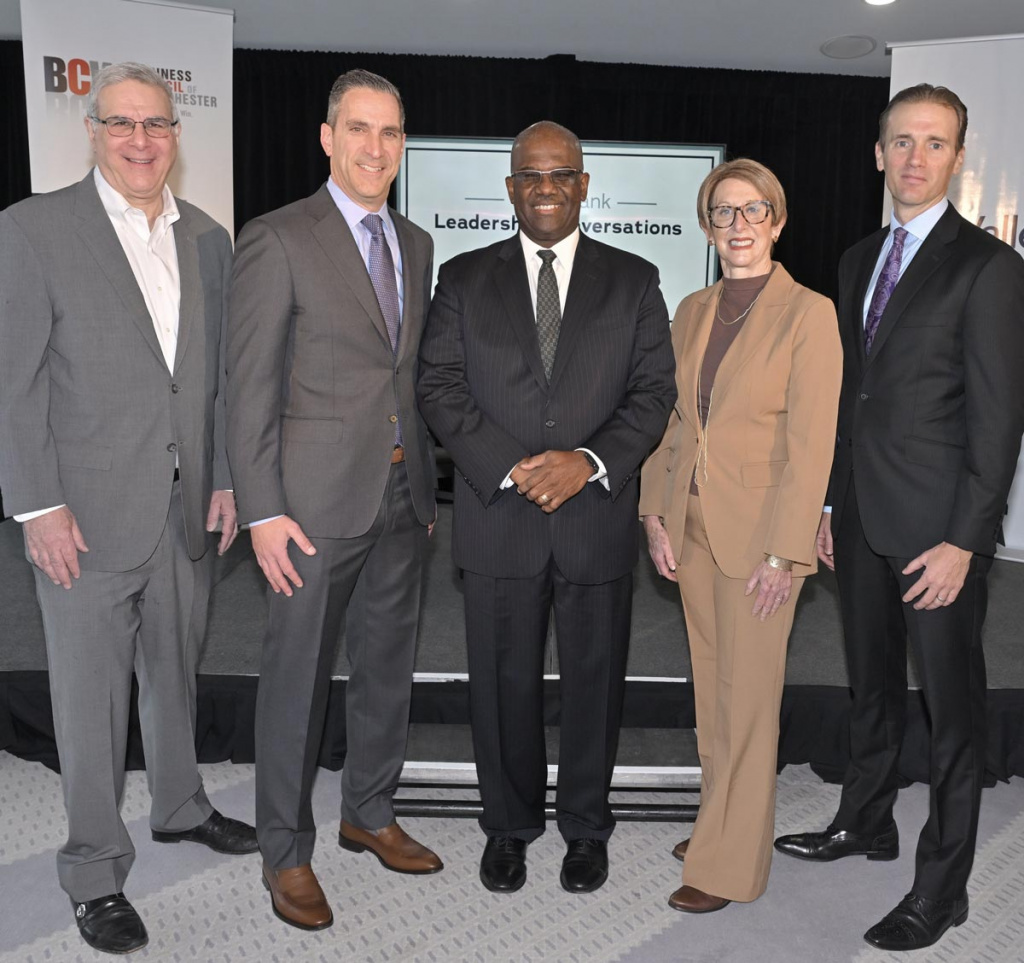
In the final BCW Valley Bank Leadership Conversations series of the year, Deputy Westchester County Executive Ken Jenkins was the featured speaker this week at a standing-room-only crowd of business, government, and non-profit leaders.
BCW President and CEO Marsha Gordon led a stimulating one-hour conversation at Kanopi restaurant in downtown White Plains. “The BCW has enjoyed a long and positive relationship with Ken Jenkins from his time as a member and later chair of the County Legislators, and of course in his seven years as Deputy County Executive. Now, as Ken moves into the role of Interim County Executive, we are very much looking forward to working together in continuing to create economic opportunities for all in Westchester,” said Gordon.
Jenkins is expected to be named Interim County Executive by the County Board of Legislators on January 2 replacing George Latimer, who in November was elected to the U.S. House of Representatives. A special election will be held within 90 days in which Jenkins hopes to be elected County Executive for the remaining nine months of Latimer’s term. He will also run in November for election to serve a full term as County Executive effective January 1, 2026.
In his opening remarks, Jenkins stated that he looks forward to continuing to build relationships with the BCW and their members to jointly address economic development; fiscal challenges facing the county in 2025; social issues; and sustainability.
A Yonkers resident and a graduate of Iona University in New Rochelle, he began the conversation by proudly noting that his father was a New York City police lieutenant and his mother a nurse. They exemplified a dedication to public service, and that motivated his desire to continue their legacy by helping his community.
On the county’s 2025 budget, Jenkins noted a sixth year of a zero percent tax levy increase while maintaining critical services for residents. He also noted how the Latimer administration successfully raised the county’s fund balance since 2018 from $78 million to more than $500 million, which prompted credit agencies to raise the county’s credit ratings and lower the county’s borrowing costs.
Jenkins said that as county executive he will continue the good work of the Latimer administration, which balanced fiscal responsibility with the needs of Westchester’s diverse residents.
On economic development, Jenkins described the county’s support for local entrepreneurs, minority- and women-owned businesses, local chambers of commerce, the startup accelerator program Element 46, and outreach to biosciences firms in New York City that need expansion space—efforts led by Westchester’s Director of Economic Development Bridget Gibbons. He also noted how many local businesses cannot succeed without the county’s support for childcare subsidies that give working parents safe and affordable options.
Jenkins explained that funds from the 2021 American Rescue Plan Act allowed the Latimer administration to set up the 2023 Housing Flex Fund focusing on affordable and workforce housing led by the Westchester’s Planning Commissioner Blanca Lopez. In May, the county committed $3 million to helping the Town of Mamaroneck build more affordable housing. Under the Latimer administration, the county developed 2,500 units of affordable housing.
Public safety will remain a priority, he said. The county is allocating a record $303 million that supports new correction officer classes and 308 police officers.
He also emphasized the important need for expanding complex mental health services. Examples of the county’s efforts to refine mental health delivery include dedicated mental health responders who have bolstered the safety of residents in psychological crisis. Another solution was keeping homeless shelters open 24/7 to give county staff more time to help a fragile population.
He pledged to continue the county’s efforts to work with residents and local municipalities in moving toward more environmentally sustainable practices through initiatives like composting and food scrap and textile recycling led by Director of Energy & Sustainability Peter McCartt.
More News
The Business Council of Westchester’s Clean Energy Action Coalition (CEAC) has long championed the investments needed to modernize New York’s energy infrastructure. The Smart Path Connect marks another significant milestone in that effort, a transformative transmission project that will strengthen the state’s electric grid, unlock greater capacity and reliability, and deliver an estimated $438 million […]
The Westchester County Board of Legislators has approved a $156.8 million budget for BCW member SUNY Westchester Community College (WCC) for the 2026–2027 academic year, reaffirming the County’s commitment to expanding access to higher education, workforce development, and economic opportunity throughout the region. The approved budget includes $132.7 million in operating funding and $24.1 million […]
Milestone Anniversary Honors Legacy of Free Summer Camp That Has Changed the Lives of More Than 8,000 Westchester Children NORTH SALEM, N.Y. (July 30, 2026) – BCW member The Westchester Parks Foundation, joined by Westchester County Executive Ken Jenkins, County officials, former camp directors, past and present staff, alumni, current campers, and longtime supporters, celebrated […]
Become A Member
Join the county’s largest and most influential business organization today.
JOIN NOW!